Saturday, 15 December 2012

Happy


Smiling is much easier than explaining why you're sad.
Crying won't bring him back.It's just you're luck
He can't hurt you now. He may left you with someone else.
He just proved himself that he is not worth a thing to you.
I may be broken now but I know in time I will be able to pick myself up
And be as happy as I can possibly be :)

Elements of a Short Story

Elements of a Short Story
SETTING -- The time and location in which a story takes place is called the setting. For some stories the setting is very important, while for others it is not. There are several aspects of a story's setting to consider when examining how setting contributes to a story (some, or all, may be present in a story):
a) place - geographical location. Where is the action of the story taking place?
b) time - When is the story taking place? (historical period, time of day, year, etc)
c) weather conditions - Is it rainy, sunny, stormy, etc?
d) social conditions - What is the daily life of the characters like? Does the story contain local colour (writing that focuses on the speech, dress, mannerisms, customs, etc. of a particular place)?
e) mood or atmosphere - What feeling is created at the beginning of the story? Is it bright and cheerful or dark and frightening?
BACK TO TOP


PLOT -- The plot is how the author arranges events to develop his basic idea; It is the sequence of events in a story or play. The plot is a planned, logical series of events having a beginning, middle, and end. The short story usually has one plot so it can be read in one sitting. There are five essential parts of plot:
a) Introduction - The beginning of the story where the characters and the setting is revealed. b) Rising Action - This is where the events in the story become complicated and the conflict in the story is revealed (events between the introduction and climax). c) Climax - This is the highest point of interest and the turning point of the story. The reader wonders what will happen next; will the conflict be resolved or not? d) Falling action - The events and complications begin to resolve themselves. The reader knows what has happened next and if the conflict was resolved or not (events between climax and denouement). e) Denouement - This is the final outcome or untangling of events in the story.


It is helpful to consider climax as a three-fold phenomenon: 1) the main character receives new information 2) accepts this information (realizes it but does not necessarily agree with it) 3) acts on this information (makes a choice that will determine whether or not he/she gains his objective).

BACK TO TOP
CONFLICT-- Conflict is essential to plot. Without conflict there is no plot. It is the opposition of forces which ties one incident to another and makes the plot move. Conflict is not merely limited to open arguments, rather it is any form of opposition that faces the main character. Within a short story there may be only one central struggle, or there may be one dominant struggle with many minor ones.
There are two types of conflict:
1) External - A struggle with a force outside one's self.

2) Internal - A struggle within one's self; a person must make some decision, overcome pain, quiet their temper, resist an urge, etc. There are four kinds of conflict:
1) Man vs. Man (physical) - The leading character struggles with his physical strength against other men, forces of nature, or animals.
2) Man vs. Circumstances (classical) - The leading character struggles against fate, or the circumstances of life facing him/her. 3) Man vs. Society (social) - The leading character struggles against ideas, practices, or customs of other people. 4) Man vs. Himself/Herself (psychological) - The leading character struggles with himself/herself; with his/her own soul, ideas of right or wrong, physical limitations, choices, etc.

BACK TO TOP


CHARACTER -- There are two meanings for the word character:
1) The person in a work of fiction.
2) The characteristics of a person.
Persons in a work of fiction - Antagonist and Protagonist
Short stories use few characters. One character is clearly central to the story with all major events having some importance to this character - he/she is the PROTAGONIST. The opposer of the main character is called the ANTAGONIST.
The Characteristics of a Person -
In order for a story to seem real to the reader its characters must seem real. Characterization is the information the author gives the reader about the characters themselves. The author may reveal a character in several ways:
a) his/her physical appearance
b) what he/she says, thinks, feels and dreams
c) what he/she does or does not do
d) what others say about him/her and how others react to him/her
Characters are convincing if they are: consistent, motivated, and life-like (resemble real people) Characters are...
1. Individual - round, many sided and complex personalities.
2. Developing - dynamic, many sided personalities that change, for better or worse, by the end of the story.
3. Static - Stereotype, have one or two characteristics that never change and are emphasized e.g. brilliant detective, drunk, scrooge, cruel stepmother, etc.

BACK TO TOP
POINT OF VIEW Point of view, or p.o.v., is defined as the angle from which the story is told. 1. Innocent Eye - The story is told through the eyes of a child (his/her judgment being different from that of an adult) . 2. Stream of Consciousness - The story is told so that the reader feels as if they are inside the head of one character and knows all their thoughts and reactions. 3. First Person - The story is told by the protagonist or one of the characters who interacts closely with the protagonist or other characters (using pronouns I, me, we, etc). The reader sees the story through this person's eyes as he/she experiences it and only knows what he/she knows or feels. 4. Omniscient- The author can narrate the story using the omniscient point of view. He can move from character to character, event to event, having free access to the thoughts, feelings and motivations of his characters and he introduces information where and when he chooses. There are two main types of omniscient point of view: a) Omniscient Limited - The author tells the story in third person (using pronouns they, she, he, it, etc). We know only what the character knows and what the author allows him/her to tell us. We can see the thoughts and feelings of characters if the author chooses to reveal them to us. b) Omniscient Objective – The author tells the story in the third person. It appears as though a camera is following the characters, going anywhere, and recording only what is seen and heard. There is no comment on the characters or their thoughts. No interpretations are offered. The reader is placed in the position of spectator without the author there to explain. The reader has to interpret events on his own.

BACK TO TOP
THEME -- The theme in a piece of fiction is its controlling idea or its central insight. It is the author's underlying meaning or main idea that he is trying to convey. The theme may be the author's thoughts about a topic or view of human nature. The title of the short story usually points to what the writer is saying and he may use various figures of speech to emphasize his theme, such as: symbol, allusion, simile, metaphor, hyperbole, or irony.
Some simple examples of common themes from literature, TV, and film are:
- things are not always as they appear to be
- Love is blind
- Believe in yourself
- People are afraid of change
- Don't judge a book by its cover

Movie Poster Project


BY: Rosseni Marie Estilo
and
        Kent Dominic Palarion
BSHM3B TTH 9:00-10:30

Tuesday, 11 December 2012

Elements of Poetry

POETRY ASSUMPTIONS
Readers of poetry often bring with them many related assumptions:

  • That a poem is to be read for its "message,"
  • That this message is "hidden" in the poem,
  • The message is to be found by treating the words as symbols which naturally do not mean what they say but stand for something else,
  • You have to decipher every single word to appreciate and enjoy the poem.

There are no easy ways to dispel these biases. Poetry is difficult because very often its language is indirect. But so is experience - those things we think, feel, and do. The lazy reader wants to be told things and usually avoids poetry because it demands commitment and energy. Moreover, much of what poetry has to offer is not in the form of hidden meanings. Many poets like to "play" with the sound of language or offer an emotional insight by describing what they see in highly descriptive language. In fact, there can many different ways to enjoy poetry; this reflects the many different styles and objectives of poets themselves. For an overview of the many ways to read a poem, click here. Finally, if you are the type to give up when something is unclear, just relax! Like we just said, there can be many different approaches to examining poetry; often these approaches (like looking for certain poetic devices or examining the meaning of a specific phrase) do not require a complete and exhaustive analysis of a poem. So, enjoy what you do understand!

FIRST APPROACHES

Read the poem (many students neglect this step). Identify the speaker and the situation. Feel free to read it more than once! Read the sentences literally. Use your prose reading skills to clarify what the poem is about.Read each line separately, noting unusual words and associations. Look up words you are unsure of and struggle with word associations that may not seem logical to you.Note any changes in the form of the poem that might signal a shift in point of view. Study the structure of the poem, including its rhyme and rhythm (if any). Re-read the poem slowly, thinking about what message and emotion the poem communicates to you.


STRUCTURE and POETRYAn important method of analyzing a poem is to look at the stanza structure or style of a poem. Generally speaking, structure has to do with the overall organization of lines and/or the conventional patterns of sound. Again, many modern poems may not have any identifiable structure (i.e. they are free verse), so don't panic if you can't find it!
STANZAS: Stanzas are a series of lines grouped together and separated by an empty line from other stanzas. They are the equivalent of a paragraph in an essay. One way to identify a stanza is to count the number of lines. Thus:

  • couplet (2 lines)
  • tercet (3 lines)
  • quatrain (4 lines)
  • cinquain (5 lines)
  • sestet (6 lines)

A poem often has a specific pattern of stanza lines, rhyme scheme and/or rhythm, and many types of poems can be identified by their particular patterns:


Haiku: It has an unrhymed verse form having three lines (a tercet) and usually 5,7,5 syllables, respectively.
Limerick: It has a very structured poem, usually humorous & composed of five lines (a cinquain), in an aabba rhyming pattern; beat must be anapestic (weak, weak, strong) with 3 feet in lines 1, 2, & 5 and 2 feet in lines 3 & 4.
Sonnet: It is a lyric poem (see below) consisting of 14 lines. In English, generally the two basic kinds of sonnets are the Italian or Petrarchan sonnet and the Shakespearean or Elizabethan sonnet. The Italian/Petrarchan sonnet is named after Petrarch, an Italian Renaissance poet. The Petrarchan sonnet consists of an octave (eight lines) and a sestet (six lines). The Shakespearean sonnet consists of three quatrains (four lines each) and a concluding couplet (two lines). The Petrarchan sonnet tends to divide the thought into two parts (argument and conclusion); the Shakespearean, into four.


FORM
: A
poem may or may not have a specific number of lines, rhyme scheme and/or metrical pattern, but it can still be labeled according to its form or style. Here are the three most common types of poems according to form:

1. Lyric Poetry: It is any poem with one speaker (not necessarily the poet) who expresses strong thoughts and feelings. Most poems, especially modern ones, are lyric poems.


2. Narrative Poem:
It is a poem that tells a story; its structure resembles the plot line of a story [i.e. the introduction of conflict and characters, rising action, climax and the denouement].
3. Descriptive Poem: It is a poem that describes the world that surrounds the speaker. It uses elaborate imagery and adjectives. While emotional, it is more "outward-focused" than lyric poetry, which is more personal and introspective.
In a sense, almost all poems, whether they have consistent patterns of sound and/or structure, or are free verse, are in one of the three categories above. Or, of course, they may be a combination of 2 or 3 of the above styles! Here are some more types of poems that are subtypes of the three styles above:
Elegy: It is a lyric poem that mourns the dead. It has no set metric or stanzaic pattern, but it usually begins by reminiscing about the dead person, then laments the reason for the death, and then resolves the grief by concluding that death leads to immortality. It often uses "apostrophe" as a literary technique.
Sonnet: The sonnet is a lyric poem. Ballad: It is a narrative poem that has a musical rhythm and can be sung.
Epic: It is a long narrative poem in elevated style recounting the deeds of a legendary or historical hero.
Qualities of an Epic Poem:
  • narrative poem of great scope; dealing with the founding of a nation or some other heroic theme requires a dignified theme requires an organic unity requires orderly progress of the action always has a heroic figure or figures involves supernatural forces
  • written in deliberately ceremonial style

Ode: It is usually a lyric poem of moderate length, with a serious subject, an elevated style, and an elaborate stanza pattern.

For more about poetic forms, see the Open School Notes on Poetry Forms.


SOUND PATTERNS

Three other elements of poetry are rhyme scheme, meter (ie. regular rhythm) and word sounds (like alliteration). These are sometimes collectively called sound play because they take advantage of the performative, spoken nature of poetry.


RHYME

Rhyme is the repetition of similar sounds. In poetry, the most common kind of rhyme is the end rhyme, which occurs at the end of two or more lines. It is usually identified with lower case letters, and a new letter is used to identify each new end sound. Take a look at the rhyme scheme for the following poem :


I saw a fairy in the wood,
He was dressed all in green.
He drew his sword while I just stood,
And realized I'd been seen.

The rhyme scheme of the poem is abab.

.

Internal rhyme occurs in the middle of a line, as in these lines from Coleridge, "In mist or cloud, on mast or shroud" or "Whiles all the night through fog-smoke white" ("The Ancient Mariner"). Remember that most modern poems do not have rhyme.


NOTE: Rhyme (above) and rhythm (below) are two totally different concepts!


RHYTHM AND METER

I recommend starting with this podcast on rhythm and meter.
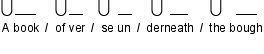

Meter: the systematic regularity in rhythm; this systematic rhythm (or sound pattern) is usually identified by examining the type of "foot" and the number of feet.

1. Poetic Foot: The traditional line of metered poetry contains a number of rhythmical units, which are called feet. The feet in a line are distinguished as a recurring pattern of two or three syllables ("apple" has 2 syllables, "banana" has 3 syllables, etc.). The pattern, or foot, is designated according to the number of syllables contained, and the relationship in each foot between the strong and weak syllables.Thus:__ = a stressed (or strong, or LOUD) syllableU = an unstressed (or weak, or quiet) syllable

In other words, any line of poetry with a systematic rhythm has a certain number of feet, and each foot has two or three syllables with a constant beat pattern .
a. Iamb (Iambic) - weak syllable followed by strong syllable. [Note that the pattern is sometimes fairly hard to maintain, as in the third foot.]
b. Trochee (Trochaic): strong syllable followed by a weak syllable.
c. Anapest (Anapestic): two weak syllables followed by a strong syllable.
e.g.
In her room at the prow of the house
Where light breaks, and the windows are tossed...


From "The Writer", by Richard Wilbur


d. Dactyl (Dactylic): a strong syllable followed by two weak syllables.DD

Here's another (silly) example of dactylic rhythm.
DDDA was an / archer, who / shot at a / frog
DDDB was a / butcher, and / had a great / dog
DDDC was a / captain, all / covered with / lace
DDDD was a / drunkard, and / had a red / face.

e. Spondee (Spondaic): two strong syllables (not common as lines, but appears as a foot). A spondee usually appears at the end of a line.


2. The Number of Feet
: The second part of meter is the number of feet contained in a line.

Thus:
one foot=monometer
two feet=dimeter
three feet=trimeter
four feet=tetrameter
five feet=pentameter
six feet=hexameter (when hexameter is in iambic rhythm, it is called an alexandrine)
Poems with an identifiable meter are therefore identified by the type of feet (e.g. iambic) and the number of feet in a line (e.g. pentameter). The following line is iambic pentameter because it (1) has five feet [pentameter], and (2) each foot has two syllables with the stress on the second syllable [iambic].
That time | of year | thou mayst | in me | behold
Thus, you will hear meter identified as iambic pentameter, trochaic tetrameter, and so on.


3. Irregularity:
Many metered poems in English avoid perfectly regular rhythm because it is monotonous. Irregularities in rhythm add interest and emphasis to the lines. In this line:


The first foot substitutes a trochee for an iamb. Thus, the basic iambic pentameter is varied with the opening trochee.


4. Blank Verse:
Any poetry that does have a
set metrical pattern (usually iambic pentameter), but does not have rhyme, is blank verse. Shakespeare frequently used unrhymed iambic pentameter in his plays; his works are an early example of blank verse.


5. Free Verse:
Most modern poetry no longer follows strict rules of meter or rhyme, especially throughout an entire poem. Free verse, frankly, has no rules about meter or rhyme whatsoever! [In other words, blank verse has rhythm, but no rhyme, while free verse has neither rhythm nor rhyme.] So, you may find it difficult to find regular iambic pentameter in a modern poem, though you might find it in particular lines. Modern poets do like to throw in the occasional line or phrase of metered poetry, particularly if they’re trying to create a certain effect. Free verse can also apply to a lack of a formal verse structure.


How?How do I know if a poem has meter? How do I determine the meter?
To maintain a consistent meter, a poet has to choose words that fit. For example, if a poet wants to write iambic poetry, s/he has to choose words that have a naturally iambic rhythm. Words like betray and persuade will work in an iambic poem because they are naturally iambic. They sound silly any other way. However, candle and muscle will work best in a trochaic poem, because their natural emphasis is on the first syllable. (However, a poet can use trochaic words if s/he places a one syllable word in front of them. This often leads to poetic feet ending in the middle of words - after one syllable - rather than the end.) It's not surprising that most modern poetry is not metered, because it is very restrictive and demanding.
Determining meter is usually a process of elimination. Start reading everything in iambic by emphasizing every second syllable. 80 to 90% of metered poetry is iambic. If it sounds silly or strange, because many of the poem's words do not sound natural, then try trochaic, anapestic or dactylic rhythms. If none of these sounds natural, then you probably do not have metered poetry at all (ie. it's free verse).
If there are some lines that sound metered, but some that don't, the poem has an irregular rhythm.
For more help, try this review of metered poetry.


For more about verse, see the Open School Notes on Verse.


For more about poetic rhythm, meter and rhyme, see the Open School Notes on rhythm, meter and rhyme.


WORD SOUNDS Another type of sound play is the emphasis on individual sounds and words:

Alliteration: the repetition of initial sounds on the same line or stanza - Big bad Bob bounced bravely.Assonance: the repetition of vowel sounds (anywhere in the middle or end of a line or stanza) - Tilting at windmillsConsonance: the repetition of consonant sounds (anywhere in the middle or end of a line or stanza) - And all the air a solemn stillness holds. (T. Gray)
Onomatopoeia: words that sound like that which they describe - Boom! Crash! Pow! Quack! Moo! Caress...


MEANING and POETRY

I said earlier that poetry is not always about hidden or indirect meanings (sometimes called meaning play). Nevertheless, if often is a major part of poetry, so here some of the important things to remember:


CONCRETENESS and PARTICULARITY

In general, poetry deals with particular things in concrete language, since our emotions most readily respond to these things. From the poem's particular situation, the reader may then generalize; the generalities arise by implication from the particular. In other words, a poem is most often concrete and particular; the "message," if there is any, is general and abstract; it's implied by the images.

Images, in turn, suggest meanings beyond the mere identity of the specific object. Poetry "plays" with meaning when it identifies resemblances or makes comparisons between things; common examples of this "figurative" comparison include:

  • ticking of clock = mortality
  • hardness of steel = determination
  • white = peace or purity

Such terms as connotation, simile, metaphor, allegory, and symbol are aspects of this comparison. Such expressions are generally called figurative or metaphorical language.


DENOTATION AND CONNOTATION

Word meanings are not only restricted to dictionary meanings. The full meaning of a word includes both the dictionary definition and the special meanings and associations a word takes in a given phrase or expression. For example, a tiger is a carnivorous animal of the cat family. This is the literal or denotative meaning. But we have certain associations with the word: sinuous movement, jungle violence, and aggression. These are the suggestive, figurative or connotative meanings.


FIGURATIVE/CONNOTATIVE DEVICES

  1. Simile is the rhetorical term used to designate the most elementary form of resemblances: most similes are introduced by "like" or "as." These comparisons are usually between dissimilar situations or objects that have something in common, such as "My love is like a red, red rose."
  2. A metaphor leaves out "like" or "as" and implies a direct comparison between objects or situations. "All flesh is grass." For more on metaphor, click here.
  3. Synecdoche is a form of metaphor, which in mentioning an important (and attached) part signifies the whole (e.g. "hands" for labour).
  4. Metonymy is similar to synecdoche; it's a form of metaphor allowing an object closely associated (but unattached) with a object or situation to stand for the thing itself (e.g. the crown or throne for a king or the bench for the judicial system).
  5. A symbol is like a simile or metaphor with the first term left out. "My love is like a red, red rose" is a simile. If, through persistent identification of the rose with the beloved woman, we may come to associate the rose with her and her particular virtues. At this point, the rose would become a symbol.
  6. Allegory can be defined as a one to one correspondence between a series of abstract ideas and a series of images or pictures presented in the form of a story or a narrative. For example, George Orwell's Animal Farm is an extended allegory that represents the Russian Revolution through a fable of a farm and its rebellious animals.
  7. Personification occurs when you treat abstractions or inanimate objects as human, that is, giving them human attributes, powers, or feelings (e.g., "nature wept" or "the wind whispered many truths to me").
  8. Irony takes many forms. Most basically, irony is a figure of speech in which actual intent is expressed through words that carry the opposite meaning.

    • Paradox: usually a literal contradiction of terms or situations
    • Situational Irony: an unmailed letter
    • Dramatic Irony: audience has more information or greater perspective than the characters
    • Verbal Irony: saying one thing but meaning another
      • Overstatement (hyperbole)
      • Understatement (meiosis)
      • Sarcasm

Irony may be a positive or negative force. It is most valuable as a mode of perception that assists the poet to see around and behind opposed attitudes, and to see the often conflicting interpretations that come from our examination of life.
For more on irony, read the FVDES Notes on Irony.


For more about words used for "sound play," see the Open School Notes on Figurative Language.


POETRY AS A LANGUAGE OF INDIRECTION

Thus, if we recognize that much of the essential quality of our experience is more complex than a simple denotative statement can describe, then we must recognize the value of the poet's need to search for a language agile enough to capture the complexity of that experience. Consider this four-line stanza:

O Western wind, when wilt thou blow
That the small rain down can rain?
Christ, that my love were in my arms,
And I in my bed again!

The center of the poem is the lover's desire to be reunited with his beloved (lines 3 and 4). But the full meaning of the poem depends on the first two lines also. Obviously, the lover associates his grief with the wind and rain, but the poet leaves to implication, to indirection, just how the lover's situation and the wind and rain are related. We note that they are related in several ways: the need for experiencing and manifesting love is an inherent need, like nature's need for rain; in a word, love, like the wind and rain, is natural. Secondly, the lover is living in a kind of drought or arid state that can only be slaked by the soothing presence of the beloved. Thirdly, the rising of the wind and the coming of the rain can neither be controlled nor foretold exactly, and human affairs, like the lover's predicament, are subject to the same sort of chance.

Undoubtedly, too, there are associations with specific words, like "Western" or "small rain" that the reader is only half aware of but which nonetheless contribute to meaning. These associations or connotations afford a few indirections that enrich the entire poem. For example, "small rain" at once describes the kind of rain that the lover wants to fall and suggests the joy and peace of lover's tears, and "small" alone might suggest the daintiness or femininity of the beloved.


http://learn.lexiconic.net/elementsofpoetry.htm

Monday, 10 December 2012

Goodbye

Bye to you my dear
Having you was so clear
You'll always be remembered
Memories we had will forever br treasured
Until we will be again together.

(Epitaph)

Wednesday, 5 December 2012

Just Friends

Coz we're now just friends
I will forever be here
Till the end of day.


Haiku

Saturday, 1 December 2012

Letting Go


Letting go of someone you truly love is hard.
It leaves your heart scarred .
Remembering all those memories you had together
Makes it more difficult to believe in forever.

Leaving the past behind may not be easy
It will surely give you queasy.
The past may be wonderful to stay
But it will make your tomorrow gray.

Bringing the past won't change a thing
It just gives your heart a sting.
Learning to let go can make you happier
Knowing that life will be more easier.

(free verse)